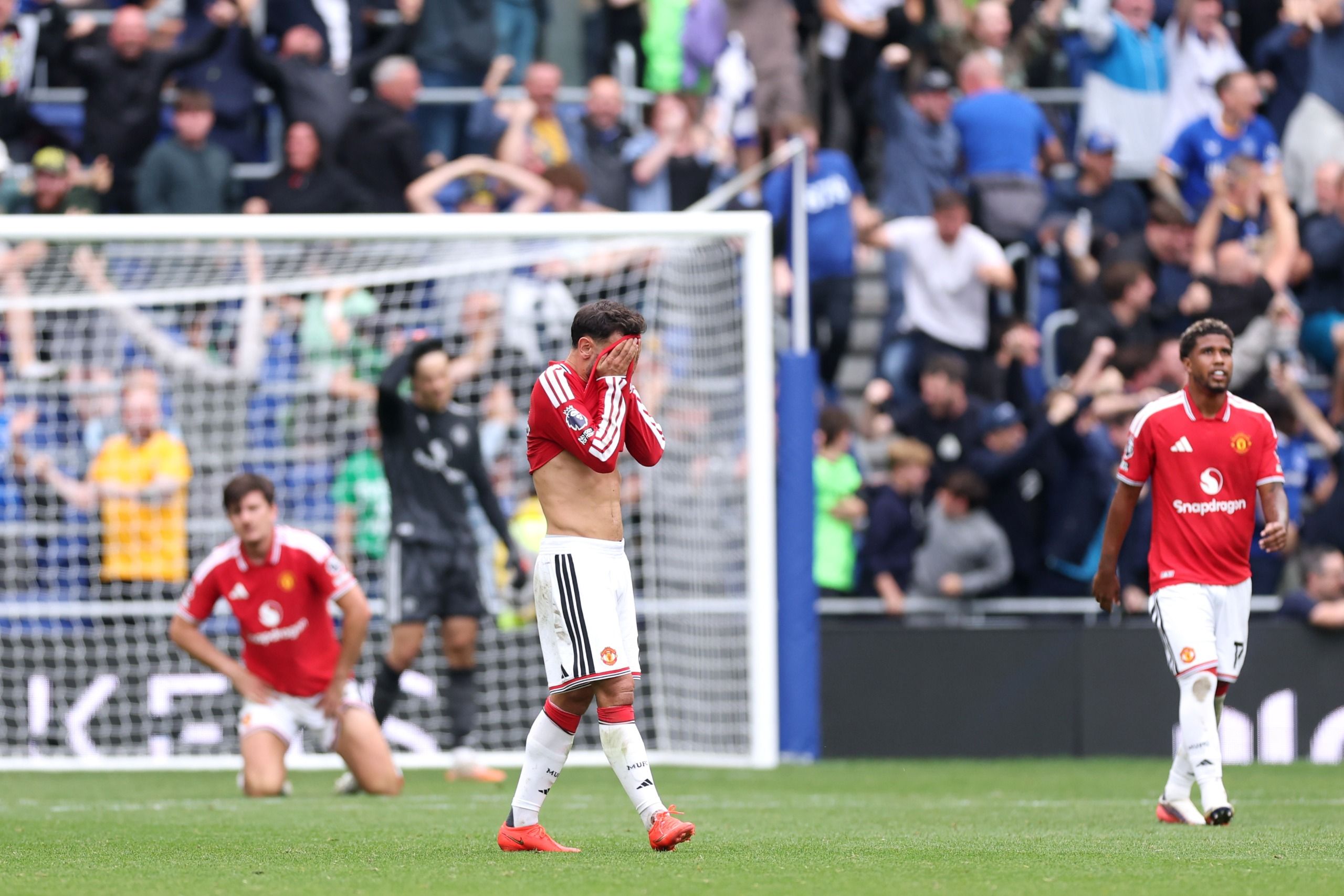
Manchester United are closing in on the halfway point of their rivals’ 30-year wait for a league title, and there is little to suggest that run will end any time soon.
“My greatest challenge was knocking Liverpool right off their f****** perch.”
Sir Alex Ferguson’s celebrated line is now so deeply woven into football folklore that people often get its origin wrong.
The former Manchester United manager did not say it in the early part of his reign, as is sometimes suggested, but during a difficult spell in September 2002. At that stage, the Red Devils had lifted seven of the previous 10 Premier League titles, while Liverpool had not yet even reached the halfway mark of their 30-year championship drought.
Ferguson made that remark during Liverpool’s 13th straight season without winning the top division. Nearly a quarter of a century later, United are themselves 13 years into a slump that began the moment the Scot stepped away.
United’s title drought is already almost half as long as the one Liverpool endured between 1990 and 2020. They are in the Premier League relegation zone ahead of today’s visit to Anfield, so it is fair to say their wait will run until at least the 2027/28 season, which would make it 15 years since they last won the league.
Clearly, 30 years is still a long way away and a great deal can change before then. But it is equally clear that United are as far from being title contenders as they have been at any point since 2013, and there is nothing to indicate that is about to change.
That problem begins at the very top. In September, executive co-chairman Avram Glazer told Deutsche Bank’s Sports Investment Conference in London that clubs of United’s size do not rely on results on the pitch to maintain commercial strength. Those remarks came to light this month as the Red Devils were preparing to dismiss manager Michael Carrick after their fall down the table.
Glazer’s words closely echoed those of former executive vice-chairman Ed Woodward in May 2018, when he told shareholders: “Playing performance doesn’t really have a meaningful impact on what we can do on the commercial side of the business.”
The fact that those two statements were made eight-and-a-half years apart points to a consistent theme: as long as the Glazer family remain majority owners, commercial returns appear likely to take precedence over football success.
The Americans also do not seem eager to part with their controlling stake, despite being deeply unpopular with supporters. A report last week said they are unlikely to move on until United’s proposed 100,000-capacity stadium has been completed — something that may not happen until 2035 — so they can maximise the value of their investment.
Other reports suggest the Glazers might consider selling their stake to co-owner Sir Jim Ratcliffe before then, but even that would hardly guarantee a revival, given the British businessman’s mixed record in football with United, French side Nice and Swiss club Lausanne-Sport.
When Ratcliffe bought a minority stake in February 2024 and assumed control of football operations, it was meant to bring an end to a decade of poor managerial decisions and overspending on players who failed to deliver.
Instead, matters have worsened, with chief executive officer Omar Berrada and director of football Jason Wilcox coming under strong criticism from fans. The Red Devils finished 15th in 2024/25 and have managed just one league win this season, while the only encouraging half-season of the Ratcliffe era came when Carrick replaced Ruben Amorim — another unsuccessful appointment — as interim boss in January and exceeded expectations by securing Champions League qualification.
In the end, United will not become a major force again without a change of ownership. As the Manchester United Supporters Trust (MUST) said after Carrick’s dismissal: “Another change of head coach cannot repair what the ownership continues to undermine.”
This is where Liverpool’s title drought offers a useful lesson. Part of the reason for the Reds’ decline through the 1990s and 2000s was that they were overtaken financially by rivals — first Ferguson’s United, then Chelsea after Roman Abramovich’s takeover — while they remained under the long-standing ownership of the Moores family.
Following the turbulent ownership of Tom Hicks and George Gillett, Fenway Sports Group (FSG) purchased Liverpool in 2010. FSG did not get everything right straight away, but once they appointed Jurgen Klopp in 2015 and placed the right people in important roles, including sporting director Michael Edwards, the Reds were able to compete regularly again for the biggest prizes.
The side that won the title in 2020 did include expensive arrivals, most notably Virgil van Dijk and Alisson, but it also featured several lower-cost signings made possible by an improved recruitment structure, such as Mo Salah, Roberto Firmino and Andy Robertson.
The crucial point, though, is that Liverpool needed 10 years under FSG to end their title drought, and that only happened once every part of the club — from the owners to the recruitment department to Klopp — was working in sync towards success on the pitch.
That is why new United manager Mauricio Pochettino can achieve only so much. As with Carrick last season, Erik ten Hag in 2022/23 and Ole Gunnar Solskjaer in 2020/21, there may be promising periods during his spell in charge, but, to borrow MUST’s point, any head coach at Old Trafford is eventually going to be undermined by the owners.
Even when the Glazers do eventually sell, there is no reason to expect United to instantly become the powerhouse they once were, as Liverpool’s story demonstrates. Returning to the summit takes time when a club has spent so long making up the numbers.
That is why it is not hard to imagine United’s title drought stretching beyond 30 years, however hypothetical that may sound at present. If the Glazers remain for the foreseeable future, any new owners would first need time to repair the damage and build the right structure for success. Only then could United begin to challenge consistently for the title again, and even then there would be no guarantee of winning it immediately.
That possibility would have sounded absurd when Ferguson delivered his famous line in 2002, but once you fall from your perch, climbing back on is never easy — as Liverpool know better than most.
Contact to : xlf550402@gmail.com
Copyright © boyuanhulian 2020 - 2023. All Right Reserved.